
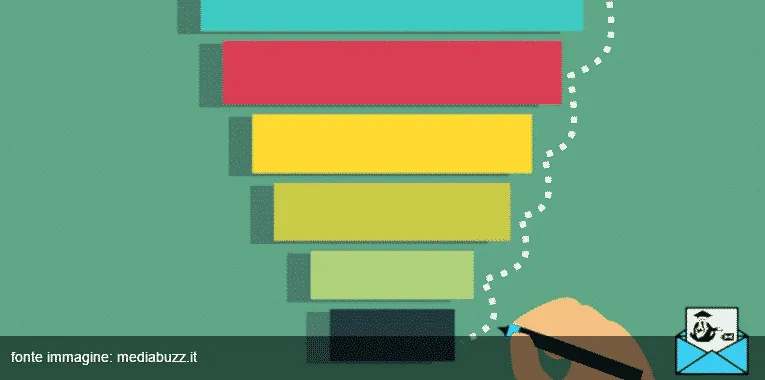
The funnel is a very popular marketing model. It represents the so-called path of purchase: the journey a user takes from casual visitor to actual paying customer.
What does funnel mean?
A funnel is, quite literally, a cone-shaped tube that narrows toward the bottom, and the analogy fits remarkably well.
As we said, the sales funnel describes the customer journey: essentially, the path a consumer follows to become a paying customer.
Just think about it.
At the wide mouth of the funnel are what you might call raw contacts, still to be filtered. At the narrow outlet you find the result of that selection: your customers.
What is it for?
The natural question is this: why should you invest in funnel marketing?
The answer is simple. It helps you build winning strategies for your business.
Remember, though, that you should always start by analyzing your buyer persona.
Study the psychographic and demographic traits of your ideal customer. Only by knowing your target audience can you win it over, convince it to buy, and build loyalty over time.
The stages of funnel marketing
Broadly speaking, the sales funnel has 3 stages. These are the 3 steps that lead any user toward a purchase.
Let’s look at them together.
- ToFu (Top of the Funnel) This is the widest part of the sales funnel. Here you find prospects: people who don’t know the company and don’t even know whether, or how much, its services or products could help them. The work here is to raise brand awareness among consumers. How? With informative material and high-quality content, such as blog posts, articles, infographics, traditional print or TV advertising, and online campaigns, including on social media and Google Ads.
- MoFu (Middle of the Funnel) This is the middle of the funnel. Leads are potential customers who know they have a problem and want to solve it. So lead nurturing continues (demos, webinars, e-books, and so on). The aim is to keep the audience engaged and spark greater interest.
- BoFu (Bottom of the Funnel) At this point the remaining users are “warm”, in other words ready to buy. All it takes is a nudge with attractive offers, discounts, and promotions.
Building a funnel
By now you can see that funnels are essential tools for anyone running a business, especially a commercial one.
If you want to try your hand at funnels and see how they work, use a dedicated platform, such as the well-known ClickFunnels, an all-in-one online marketing and sales tool that helps you build custom funnels quickly and easily.
There are many others too, including Infusionsoft, GetResponse, and ActiveCampaign.
What do they all aim for? Generating new leads and selling more, of course.